
What is Listmonk?
Listmonk is a high-performance, open-source, self-hosted mailing list and newsletter management platform designed to manage subscribers and deliver email campaigns at scale.
It provides a centralized interface for organizing mailing lists, managing subscribers, creating newsletters, designing email templates, scheduling campaigns, and monitoring delivery statistics.
Built with Go and backed by PostgreSQL, Listmonk is designed to handle large subscriber databases while maintaining a relatively small resource footprint.
The platform also provides a REST API for integrating email functionality into external applications, websites, and automated workflows.
Listmonk is particularly suitable for businesses, developers, publishers, and organizations that want to operate their own newsletter and mailing infrastructure without relying entirely on commercial email marketing platforms.
History of Listmonk
Listmonk is an open-source project developed by K. N. Adhitya (knadh).
The project was created to provide a lightweight, efficient, and self-hosted alternative to commercial mailing list and newsletter management services.
Its architecture uses Go for the backend and PostgreSQL for persistent storage, allowing the application to manage large subscriber databases and process email campaigns efficiently.
Listmonk is distributed under the GNU Affero General Public License version 3 (AGPLv3).
Key Features of Listmonk
Listmonk provides a comprehensive set of tools for managing subscribers and email marketing campaigns.
- Subscriber Management: Create, update, import, export, and organize subscriber records.
- Mailing Lists: Maintain multiple mailing lists and organize subscribers into different audiences.
- Single and Double Opt-In: Configure subscription confirmation workflows.
- Campaign Management: Create, schedule, pause, and manage email campaigns.
- Email Templates: Design reusable HTML email templates with dynamic content.
- Subscriber Segmentation: Filter and organize subscribers using attributes and SQL-based queries.
- Campaign Analytics: Monitor campaign performance, email opens, clicks, and delivery statistics.
- Bounce Processing: Detect and manage bounced email messages.
- Transactional Emails: Send individual transactional messages through the API.
- REST API: Integrate subscriber management, campaigns, templates, and transactional messaging into external applications.
- Multiple SMTP Servers: Configure multiple email delivery servers and sending queues.
- Rate Limiting: Control email delivery throughput and sending rates.
- Media Management: Upload and manage images and other assets used in email campaigns.
- Custom Attributes: Store additional subscriber information using flexible JSON attributes.
- Role-Based Permissions: Configure user roles and permissions for administrative access.
- OpenID Connect: Support external authentication through compatible identity providers.
- Docker Support: Deploy the application using Docker and Docker Compose.
- High Performance: Handle large mailing lists with efficient database queries and concurrent email delivery.
Use Cases
Listmonk is suitable for organizations and individuals that need to manage subscribers and distribute email communications.
Common use cases include:
- Newsletters: Publish regular newsletters to subscribers and community members.
- Business Marketing: Send product announcements, promotions, and company updates.
- Customer Communication: Distribute important information to existing customers.
- Product Updates: Notify users about new features, releases, and improvements.
- Community Management: Maintain mailing lists for communities, organizations, and online publications.
- Educational Communications: Send course announcements, learning materials, and institutional updates.
- Transactional Messaging: Integrate individual email delivery into applications through the API.
- Subscriber Management: Maintain organized subscriber databases with custom attributes and segmentation.
- Campaign Analysis: Evaluate email engagement through campaign statistics.
- Application Integrations: Automate mailing list operations through the REST API.
Benefits of Listmonk
- Open-source and self-hosted email marketing platform
- High-performance mailing list management
- Supports large subscriber databases
- Efficient Go-based application architecture
- PostgreSQL-backed persistent storage
- Multiple mailing lists and subscriber segmentation
- Single and double opt-in subscription workflows
- Reusable email templates and dynamic content
- Campaign scheduling and performance analytics
- Bounce processing and delivery monitoring
- REST API for external integrations
- Support for multiple SMTP servers
- Configurable email delivery throughput
- Role-based access control
- No mandatory third-party email marketing platform
How to Install Listmonk
To install Listmonk through Esadax, follow these steps:
- Purchase the application through Esadax.
- After purchasing, you will be prompted to provide the required configuration parameters.
- Enter the requested configuration values, including database credentials.
- Configure persistent storage for the application and PostgreSQL database.
- Click Deploy to launch the application.
- Access the Listmonk administration interface through its assigned application URL.
- Complete the initial administrator account setup if it has not already been configured.
- Configure your SMTP server for outgoing email delivery.
- Create your first mailing list and configure its subscription settings.
- Import existing subscribers or allow visitors to subscribe through your forms.
- Create an email template and prepare your first campaign.
- Send a test email before launching a campaign.
Once configured, Listmonk provides a centralized environment for managing subscribers and distributing email campaigns.
Subscriber Management
Listmonk provides a dedicated subscriber management system for maintaining mailing list contacts.
Each subscriber is identified by an email address and can have an associated name and additional custom attributes.
Subscribers can belong to multiple mailing lists, allowing organizations to manage different audiences without maintaining separate subscriber databases.
Subscriber management includes:
- Creating and editing subscriber records
- Importing subscribers from supported formats
- Exporting subscriber information
- Managing subscription statuses
- Organizing subscribers into mailing lists
- Assigning custom attributes
- Searching and filtering subscriber records
- Managing blocked and unsubscribed addresses
- Reviewing subscriber activity
This centralized approach makes it easier to maintain mailing lists and manage subscriber information across multiple campaigns.
Mailing Lists and Subscription Management
Listmonk supports multiple mailing lists, allowing administrators to organize subscribers according to their interests, preferences, or communication requirements.
Each list can be configured with its own subscription settings.
Listmonk supports two primary subscription workflows:
- Single Opt-In: Subscribers are added to a mailing list without requiring an additional confirmation step.
- Double Opt-In: Subscribers must confirm their subscription through an email before receiving campaign messages.
Double opt-in is particularly useful for maintaining subscriber consent and reducing unwanted subscriptions.
Administrators can also configure public subscription pages and integrate subscription forms into external websites.
Subscriber Segmentation
Listmonk provides subscriber segmentation capabilities for creating targeted email audiences.
Subscribers can have custom attributes represented as JSON data, allowing administrators to store additional information beyond standard contact details.
Examples include:
- Location
- Preferred language
- Customer type
- Subscription preferences
- Product interests
- Account status
Subscribers can be queried and segmented using SQL expressions and their associated attributes.
This allows administrators to create more targeted campaigns instead of sending every message to the entire subscriber database.
For example, a business can maintain separate segments for customers interested in different products or subscribers associated with particular geographical regions.
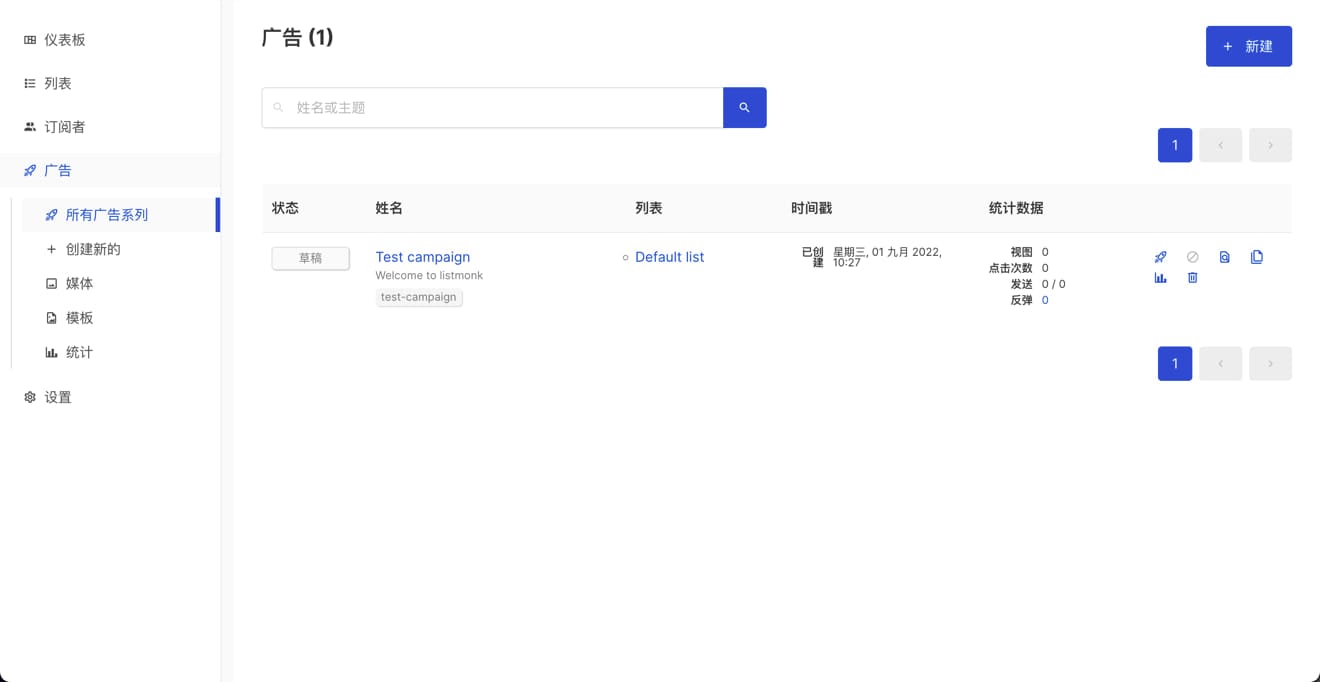
Campaign Management
Campaign management is one of Listmonk's primary features.
Administrators can create email campaigns, select their target mailing lists, prepare message content, and schedule delivery.
Campaign functionality includes:
- Creating and editing campaigns
- Selecting one or more recipient lists
- Configuring email subjects and sender information
- Using reusable email templates
- Sending test messages
- Scheduling campaigns for later delivery
- Starting and pausing campaigns
- Monitoring campaign progress
- Reviewing campaign statistics
Campaigns can be used for newsletters, announcements, product updates, and other one-way email communications.
Listmonk also provides controls for managing email delivery throughput when sending to large subscriber databases.
Email Templates and Customization
Listmonk provides a flexible templating system for creating reusable email designs.
Administrators can create HTML templates that contain common branding elements, headers, footers, and dynamic content.
The templating system supports:
- HTML email templates
- Plain-text email content
- Markdown-based content
- Visual drag-and-drop editing
- WYSIWYG editing
- Dynamic subscriber fields
- Conditional template expressions
- Reusable campaign layouts
- Custom email headers
Listmonk uses Go template expressions and integrates Sprig template functions for advanced dynamic content.
For example, subscriber information can be inserted into an email using expressions such as:
{{ .Subscriber.Name }}
This makes it possible to personalize email campaigns using information stored in subscriber records.
Templates can also be reused for transactional messages sent through the API.
Email Delivery and SMTP Configuration
Listmonk does not function as a complete email delivery infrastructure by itself. It relies on external SMTP servers or compatible email delivery providers to send messages.
Administrators can configure one or more SMTP servers through the administration interface.
Supported configuration options include:
- SMTP hostname
- SMTP port
- Authentication username
- Authentication password
- Sender email address
- Sender name
- TLS configuration
- Connection and sending limits
- Retry settings
- Custom email headers
Multiple SMTP servers can be configured to distribute outgoing email traffic and improve delivery flexibility.
For production deployments, an established email delivery provider is recommended.
Examples include:
- Amazon SES
- Mailgun
- Postmark
- SendGrid
- Other SMTP-compatible providers
The availability of individual providers depends on their SMTP compatibility and account configuration.
Transactional Emails and API
In addition to newsletter campaigns, Listmonk supports transactional email delivery through its API.
Transactional messages are individual emails triggered by events in external applications.
Common examples include:
- Account registration confirmations
- Welcome messages
- Order confirmations
- Password reset messages
- Payment notifications
- Application alerts
Listmonk provides a REST API for managing subscribers, mailing lists, campaigns, templates, media, and transactional messages.
API access allows developers to integrate Listmonk into websites, backend services, and automation systems.
API authentication uses configured application users and their associated API tokens.
This makes Listmonk suitable for applications that require centralized email management without implementing a separate email delivery interface.
Analytics and Reporting
Listmonk includes built-in analytics for monitoring email campaign performance.
The dashboard provides statistics that help administrators understand how subscribers interact with campaign messages.
Available analytics include:
- Campaign delivery statistics
- Email open tracking
- Link click tracking
- Top-performing links
- Bounce statistics
- Campaign comparisons
- Subscriber activity
Open tracking generally relies on tracking pixels, while click tracking uses redirect links.
The accuracy of engagement statistics can be affected by email clients, privacy protection features, image blocking, and automated security scanners.
These reports are useful for evaluating campaign performance and improving future email communications.
Bounce Processing
Listmonk includes functionality for identifying and managing bounced email messages.
Bounces occur when an email cannot be delivered to its intended recipient.
The platform supports bounce processing through:
- POP3 mailbox scanning
- Bounce classification
- External provider webhooks
- Bounce management through the administration interface
It supports webhook integrations with several email delivery providers, including Amazon SES, Azure Communication Services, SendGrid, Postmark, and others.
Bounce processing helps administrators identify invalid email addresses and maintain healthier subscriber lists.
For accurate bounce handling, configure a dedicated bounce mailbox or a supported delivery-provider webhook.
Security / Administration / Configuration
Listmonk provides administrative functionality for managing users, roles, permissions, mailing lists, subscribers, and campaigns.
For secure operation, consider the following practices:
- Use strong administrator credentials.
- Enable HTTPS for all external access.
- Protect API tokens and database credentials.
- Restrict access to administrative endpoints.
- Configure appropriate user roles and permissions.
- Use authenticated SMTP connections.
- Keep Listmonk and PostgreSQL updated.
- Back up the database regularly.
- Configure bounce processing to manage failed deliveries.
- Restrict public subscription endpoints where necessary.
- Use double opt-in when appropriate.
- Protect subscriber information and personal data.
- Avoid granting campaign and template permissions to untrusted users.
Listmonk supports role-based access control and optional OpenID Connect authentication.
Special attention should be given to template permissions because Listmonk templates support powerful expressions and functions.
Best Practices for Listmonk
- Organize subscribers into meaningful mailing lists.
- Use double opt-in for subscription workflows where appropriate.
- Keep subscriber information accurate and up to date.
- Remove invalid and permanently bounced email addresses.
- Use recognizable sender names and verified sending domains.
- Configure SPF, DKIM, and DMARC for your sending domain.
- Test campaigns before sending them to large audiences.
- Use reusable templates to maintain consistent branding.
- Configure sending rate limits according to your SMTP provider.
- Monitor delivery statistics and bounce rates.
- Use subscriber segmentation for targeted communications.
- Protect API credentials and administrative accounts.
- Back up PostgreSQL and uploaded media regularly.
- Monitor server resources when sending large campaigns.
- Follow applicable email marketing and data protection regulations.
Configuration Parameters
After purchasing this application on Esadax, you will be prompted to provide the configuration parameters required by the deployment.
Esadax adds the supplied variables to the deployment so the application can be launched with the configuration it requires.
Listmonk supports configuration through a TOML configuration file or environment variables.
Environment variables corresponding to configuration file settings use the LISTMONK_ prefix, with periods represented by double underscores.
The following are common configuration parameters supported by the official Listmonk Docker deployment:
| Parameter | Description |
|---|---|
LISTMONK_app__address |
Network address and port used by the Listmonk application. |
LISTMONK_db__host |
PostgreSQL database hostname. |
LISTMONK_db__port |
PostgreSQL database port. |
LISTMONK_db__user |
Database username. |
LISTMONK_db__password |
Database password. |
LISTMONK_db__database |
Database name. |
LISTMONK_db__ssl_mode |
PostgreSQL SSL connection mode. |
LISTMONK_ADMIN_USER |
Initial Super Admin username, when configured during first-time installation. |
LISTMONK_ADMIN_PASSWORD |
Initial Super Admin password, when configured during first-time installation. |
LISTMONK_ADMIN_API_USER |
Optional Super Admin API user created during installation. |
The PostgreSQL container also uses the following variables:
| Parameter | Description |
|---|---|
POSTGRES_USER |
PostgreSQL account created for Listmonk. |
POSTGRES_PASSWORD |
Password assigned to the PostgreSQL account. |
POSTGRES_DB |
Database created for Listmonk. |
The initial administrator variables are intended for first-time setup. They do not function as a general administrator password reset mechanism.
Most additional application settings, including SMTP servers, campaign delivery configuration, and bounce processing, are managed through the Listmonk administration interface.
The exact configuration parameters depend on the Esadax deployment package. Use the values presented during the purchase and deployment process.
Once the required values are configured, click Deploy to launch Listmonk.
Database and Storage
Listmonk uses PostgreSQL as its primary database.
The database stores information such as:
- Subscriber records
- Mailing lists
- Campaigns
- Email templates
- Subscriber attributes
- Campaign analytics
- Bounce information
- Application configuration
The application also supports persistent filesystem storage for uploaded media.
For Docker deployments, the default uploaded media directory is:
/listmonk/uploads
Ensure that this directory is mounted to persistent storage when using filesystem-based media uploads.
For reliable operation:
- Use persistent PostgreSQL storage.
- Back up the database regularly.
- Include uploaded media in backup procedures.
- Monitor database growth.
- Protect database access with appropriate credentials.
- Use a supported PostgreSQL release.
- Test database restoration procedures.
PostgreSQL is an essential dependency and must remain available for Listmonk to operate.
Performance and Scalability
Listmonk is designed to handle large mailing lists while maintaining a relatively low resource footprint.
Its architecture supports concurrent email processing, multiple SMTP connections, and configurable campaign delivery rates.
For larger deployments, administrators can optimize performance through:
- SMTP connection pool configuration
- Campaign batch-size adjustments
- Sending rate limits
- PostgreSQL performance tuning
- Database query caching
- Regular database maintenance
- Appropriate server resource allocation
Listmonk documentation describes deployments managing millions of subscribers.
Actual performance depends on database size, server resources, SMTP provider limits, and campaign configuration.
Conclusion
Listmonk is a powerful, open-source, self-hosted mailing list and newsletter management platform designed for efficient email communication.
With subscriber management, mailing lists, segmentation, campaign scheduling, reusable templates, transactional messaging, API access, and built-in analytics, it provides the essential tools for operating a centralized email communication system.
Its Go-based architecture, PostgreSQL storage, and flexible SMTP integration make it suitable for businesses, developers, publishers, and organizations managing growing subscriber databases.
Listmonk is a practical solution for anyone looking for a self-hosted alternative to commercial newsletter and mailing list management platforms.